Chinatown: A Taste of Asia in Toronto’s Downtown Core
Toronto is home to several Chinese communities. However, the downtown Chinatown, centered primarily along Spadina Avenue and Dundas Street West, is its oldest and most iconic. The origins trace back to the late 19th and early 20th centuries. During this time, many Chinese immigrants were drawn to settle in Toronto. They were initially attracted by the Canadian Pacific Railway. The current downtown Chinatown flourished from the 1960s onwards. It became a bustling hub of commerce, culture, and community for generations of Chinese-Canadians. It also became a vibrant destination for all Torontonians and visitors. It’s a place rich in history, resilience, and cultural pride.
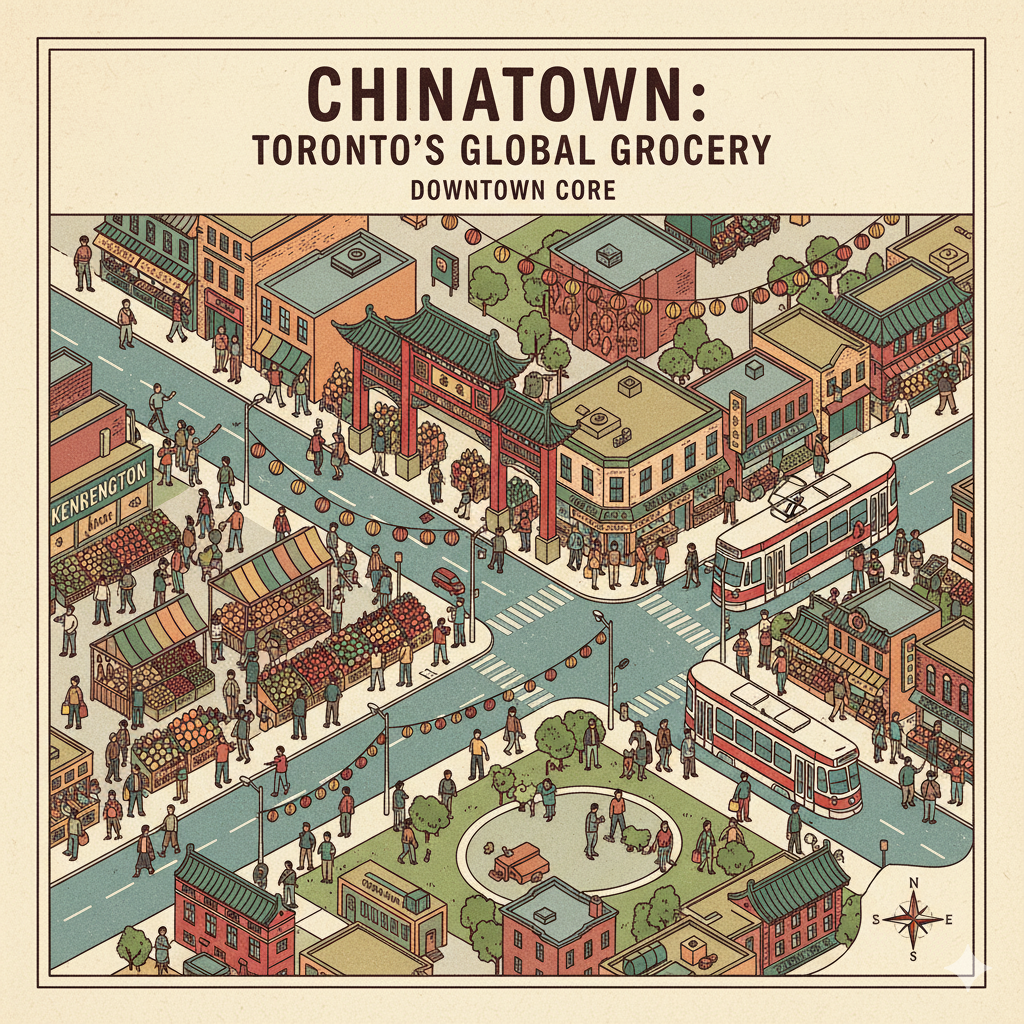
Local Vibes:
Chinatown is a feast for the senses and pulses with an invigorating energy. The local vibe is authentically bustling and incredibly diverse. The streets are a vibrant medley of sights, sounds, and smells. There are traditional Chinese bakeries and dim sum restaurants. You will find herbal medicine shops and bustling markets selling fresh produce and exotic goods. There are also unique souvenir stores. You’ll hear multiple languages spoken, see families shopping, tourists exploring, and locals enjoying delicious, affordable food. It’s a place where tradition meets modernity, creating a unique and captivating atmosphere that truly feels like a world away.
Parks:
Chinatown itself is dense with commercial and residential buildings. However, it benefits greatly from its proximity to significant green spaces. It also enjoys access to public areas.
- Grange Park: Just a short walk south of Chinatown, this large and beautiful park features the Art Gallery of Ontario. It includes a modern playground and offers plenty of open space for relaxation and community events. It’s a fantastic urban oasis.
- Bellevue Square Park: Located in the heart of Kensington Market, which borders Chinatown, this lively park is a community hub. It often hosts street performers and local gatherings.
- Alexandra Park: While slightly further west, it provides additional green space, sports facilities, and a community center.
Walkability Score Series: Chinatown Edition
Chinatown boasts an exceptional walkability score, making it one of the most pedestrian-friendly and engaging neighborhoods in Toronto.
Proximity to Transit:
Chinatown’s central downtown location ensures superb access to the TTC network.
- Spadina Station (Line 2 Bloor-Danforth & Line 1 Yonge-University): This is a major interchange. It is accessible via a short streetcar ride north on Spadina.
- St. Patrick Station (Line 1 Yonge-University): Just a short walk east on Dundas Street, providing quick access north and south.
- Osgoode Station (Line 1 Yonge-University): A bit further east, also on Dundas Street.
TTC Buses & Streetcars:
The neighborhood is incredibly well-served by streetcars, which are integral to its character.
- 510 Spadina Streetcar: The streetcar runs through the heart of Chinatown along Spadina Avenue. It connects to Union Station and the Spadina subway station.
- 505 Dundas Streetcar: Runs along Dundas Street West, providing excellent east-west connectivity.
- Numerous bus routes along University Avenue and other major streets nearby.
This comprehensive network makes navigating Toronto from Chinatown incredibly easy and efficient.
Access to Grocery Stores and Amenities:
This is where Chinatown truly shines. It offers unparalleled access to unique groceries. It also provides access to everyday amenities.
- Fresh Produce Markets: These markets are abundant along Spadina Avenue and Dundas Street. They offer a vast array of fresh, often exotic, fruits, vegetables, and seafood. Prices are competitive.
- Specialty Asian Grocers: Numerous stores selling everything from dried goods, sauces, and spices to frozen dim sum and unique ingredients.
- Butchers & Bakeries: Excellent traditional Chinese bakeries and butchers offering specific cuts and prepared foods.
- Pharmacies, banks, and other services: All readily available along the main thoroughfares.
- Kensington Market: Immediately adjacent, offering an even wider, eclectic selection of independent grocers, organic produce, and international foods.
Pedestrian-Friendly Streets:
Chinatown is a walker’s paradise. The sidewalks are wide and bustling, encouraging exploration. While traffic can be slow, pedestrians are king here, and the vibrant street life makes every walk an experience.
Hidden Gems by Postal Code
Chinatown falls largely within the M5T postal code, a treasure trove of unique finds.
- M5T (Chinatown/Grange Park/Kensington Market):
- The Lantern Shops & Souvenir Stores: They are touristy. However, they offer a fascinating array of traditional Chinese goods. You can find lucky charms and unique gifts there.
- The Secret Courtyards & Alleyways: Wander off Spadina or Dundas. You might discover hidden noodle shops. You might also find unique street art or quiet residential pockets.
- Authentic Dim Sum Restaurants: Don’t just stick to the main street! Explore the side streets and upstairs restaurants for truly authentic dim sum experiences.
- Herbal Medicine Shops: Even if you’re not buying anything, these shops are fascinating. Their walls are filled with dried herbs, roots, and traditional remedies.
- The Art Galleries around Grange Park: This area is just south of Chinatown. It is home to the Art Gallery of Ontario (AGO). It also hosts numerous smaller, independent galleries.
- Street Food Vendors: Especially in warmer months, keep an eye out for small carts selling delicious and affordable street food. Vendors offer everything from roasted chestnuts to unique snacks.
Property Value & Rental Trends
Living in Chinatown means living in the thick of downtown Toronto, making property both valuable and highly sought after. Housing stock includes historic row houses (often converted into multi-unit dwellings), and newer condo developments on its fringes.
Median Home Price Estimation:
Given its mix of residential styles, property values vary:
- Historic Row Houses: When they come on the market, these can range from $1.2 million to $2.5 million+, particularly if they are well-preserved or offer commercial space on the ground floor. Many are multi-unit income properties.
- Condominiums: Newer condo buildings located on the edges of Chinatown (e.g., along Spadina, Dundas, or University Ave) typically feature:
- One-bedroom units: $550,000 to $800,000+
- Two-bedroom units: $850,000 to $1.3 million+
Rental Trends:
The rental market in Chinatown is exceptionally strong. It is driven by students due to proximity to UofT and OCAD. Young professionals also contribute to its strength. Additionally, it attracts those who desire a truly urban and vibrant living experience.
- One-bedroom apartments/condos: Can typically rent for $2,000 to $2,700+ per month.
- Two-bedroom apartments/condos: Generally range from $2,800 to $4,000+ per month.
- Rooms in shared houses/basement apartments: Due to the area’s older housing stock, these accommodations are common. They range from $800 to $1,500 per month. Often, they include utilities.
Demand for rentals is consistently high, reflecting the desirability and convenience of living in this unique downtown neighborhood.
Schools & College in & around Chinatown
- University of Toronto – St. George Campus — the western edge of U of T is directly adjacent; New College (Spadina Crescent) is the closest college to Chinatown and notably has the largest Chinese student population of all U of T colleges
- OCAD University (100 McCaul St) — Canada’s largest art and design school, its iconic Sharp Centre building sits at the corner of McCaul and Dundas, overlooking Chinatown
- Toronto Metropolitan University (TMU) — accessible via Dundas St east, a short streetcar or walk
- George Brown College — multiple campuses reachable by TTC; the St. James Campus is the closest
- Kensington Community School — PK–Grade 6, in adjacent Kensington Market
- King Edward Junior & Senior Public School — JK–Grade 8, includes French Immersion
- Ogden Junior Public School — JK–Grade 6, within the Chinatown catchment
- Ryerson Community School — located on Denison Ave in the heart of Chinatown, beside the Sanderson Branch of the Toronto Public Library
- Harbord Collegiate Institute (286 Harbord St) — Grades 9–12, TDSB
- Jarvis Collegiate Institute (495 Jarvis St) — Grades 9–12, one of Ontario’s oldest public secondary schools
- Collège français secondaire — French-language public secondary
- ÉÉ Gabrielle-Roy — French public elementary
- ÉSC Saint-Frère-André — French Catholic secondary
- ÉÉC du Sacré-Coeur-Toronto — French Catholic elementary
- St. Mary Catholic School — the main TCDSB elementary school serving the Chinatown area
TTC Streetcars to Chinatown
| Nearest Stop | Streetcar Route | Direction from Neighbourhood |
|---|---|---|
| Spadina Ave & Dundas St W | 510 Spadina, 505 Dundas | Core intersection |
| Spadina Ave & College St | 510 Spadina | North edge |
| Dundas St W & Beverley St | 505 Dundas | East edge |
| Spadina Ave & Queen St W | 510 Spadina, 501 Queen | South edge |
| Refer to TTC |
Read more blogs from Enclave
 Toronto Neighbourhoods